Firi Weekly: The Japanese Yen Returns

Firi Weekly: The Japanese Yen Returns

  • Yen Surge Spooks Crypto via Carry Trade:
    • The Japanese yen strengthened amid signs the government may support the currency, raising fears of carry-trade unwinding and forced deleveraging. This triggered a rapid crypto sell-off, with Bitcoin falling to $86,200 and Ethereum to $2,800.
  • U.S. Government Shutdown Risk Jumps to 73%:
    • Democrats oppose a funding bill with a partial shutdown that could start January 30. Prediction markets price ~73% odds, risking delayed data releases and higher market uncertainty.
  • UBS Plans to Offer Crypto Trading for Wealthy Clients:
    • One of the largest asset managers in the world, UBS, may reportedly let select Swiss private-banking clients trade crypto first, then expand globally. This is an important signal from a major bank that previously took an anti-crypto stance.
  • NYSE Builds Tokenization Platform for Stocks and Funds:
    • The New York Stock Exchange (NYSE) is developing a public-blockchain issuance platform for tokenized real-world assets, aiming to launch this year pending regulatory approval.

Last Week’s Big Three

Are We Heading Into a New U.S. Government Shutdown? Last autumn, the U.S. experienced a prolonged government shutdown that disrupted parts of the federal government and injected extra uncertainty into markets. Now the setup is back on the table, with a partial shutdown increasingly plausible. Democrats have indicated they will oppose a funding bill tied to the Department of Homeland Security (DHS), which oversees agencies such as Customs and Border Protection and Immigration and Customs Enforcement (ICE), following controversial immigration enforcement actions and deadly shootings in recent weeks.

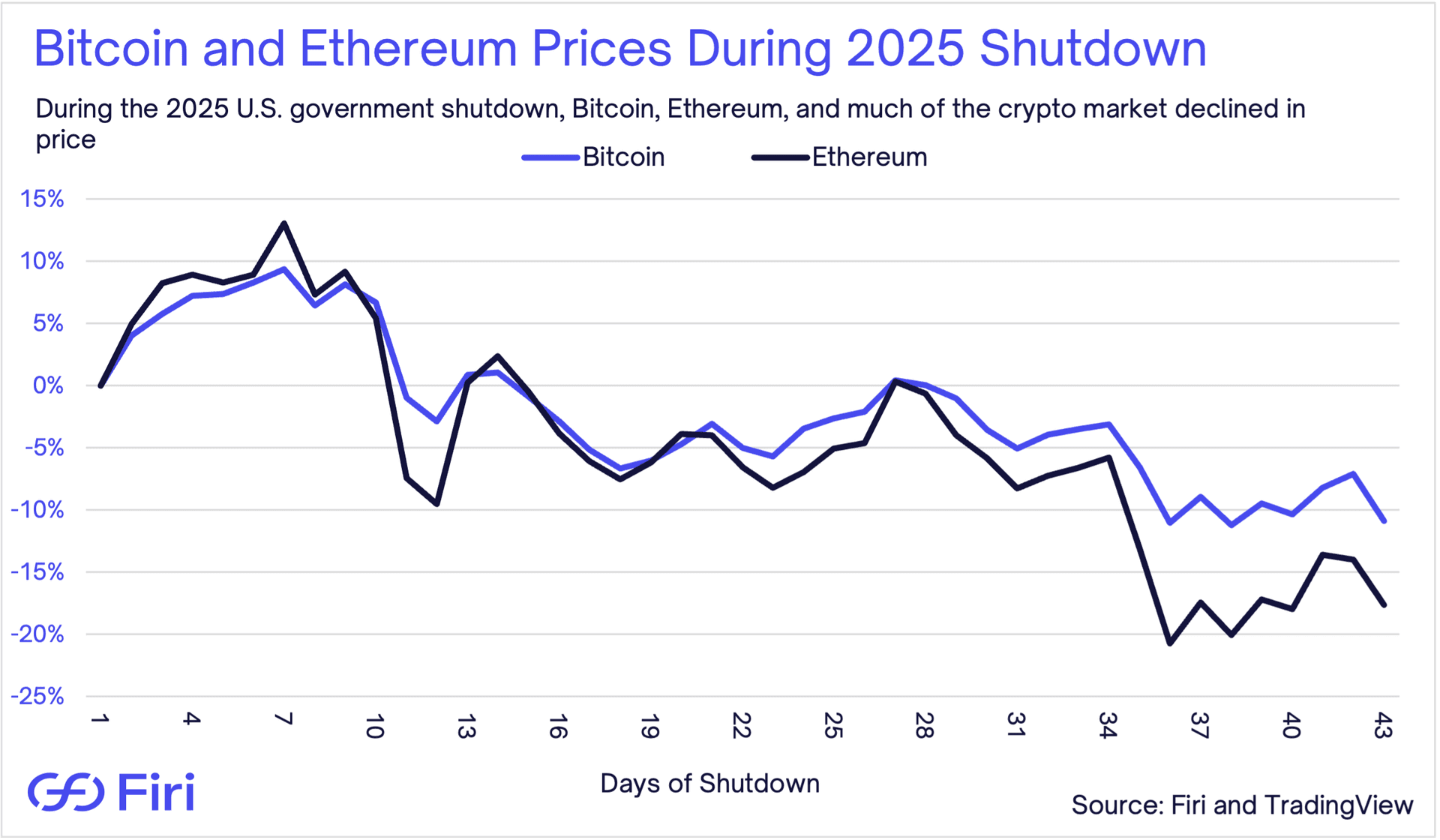
If the shutdown begins, as prediction markets currently imply with around an 73% probability, it would do so after January 30. This time around, it would likely be less extensive than last time, but still meaningful. In Chart 2, we revisit how crypto traded during the last shutdown and outline the channels through which another shutdown could weigh on sentiment—primarily via delayed economic releases and a weaker U.S. economy.

UBS Plans to Offer Crypto Trading For Select Clients: Bloomberg reports that UBS, one of the largest asset managers in the world, may allow crypto trading for a subset of wealthy clients, likely beginning within its Swiss private-banking franchise before any global expansion. The bank reportedly has not finalized implementation partners.

Even if the rollout is gradual and the near-term market impact is limited, the signaling effect is real. UBS has historically been skeptical of crypto, and given its global footprint, this would be a significant endorsement.

NYSE Develops Platform for Tokenization: The New York Stock Exchange (NYSE) and its parent company, Intercontinental Exchange (ICE), announced plans last week for a platform that would enable the issuance of tokenized assets—such as stocks and funds—on public blockchains. The strategic bet is that this would allow 24/7 trading, faster settlement times, and tighter integration with decentralized finance applications, assuming regulators approve the structure. NYSE hopes to launch the platform later this year.

The NYSE move also fits a competitive pattern. In September, its main competitor, Nasdaq, reportedly asked the U.S. Securities and Exchange Commission (SEC) whether it could facilitate trading in tokenized equities on its venue. Against that backdrop, it is less surprising that the total supply of tokenized assets—also known as real-world assets (RWAs)—increased 240% last year alone.

Behind the Charts

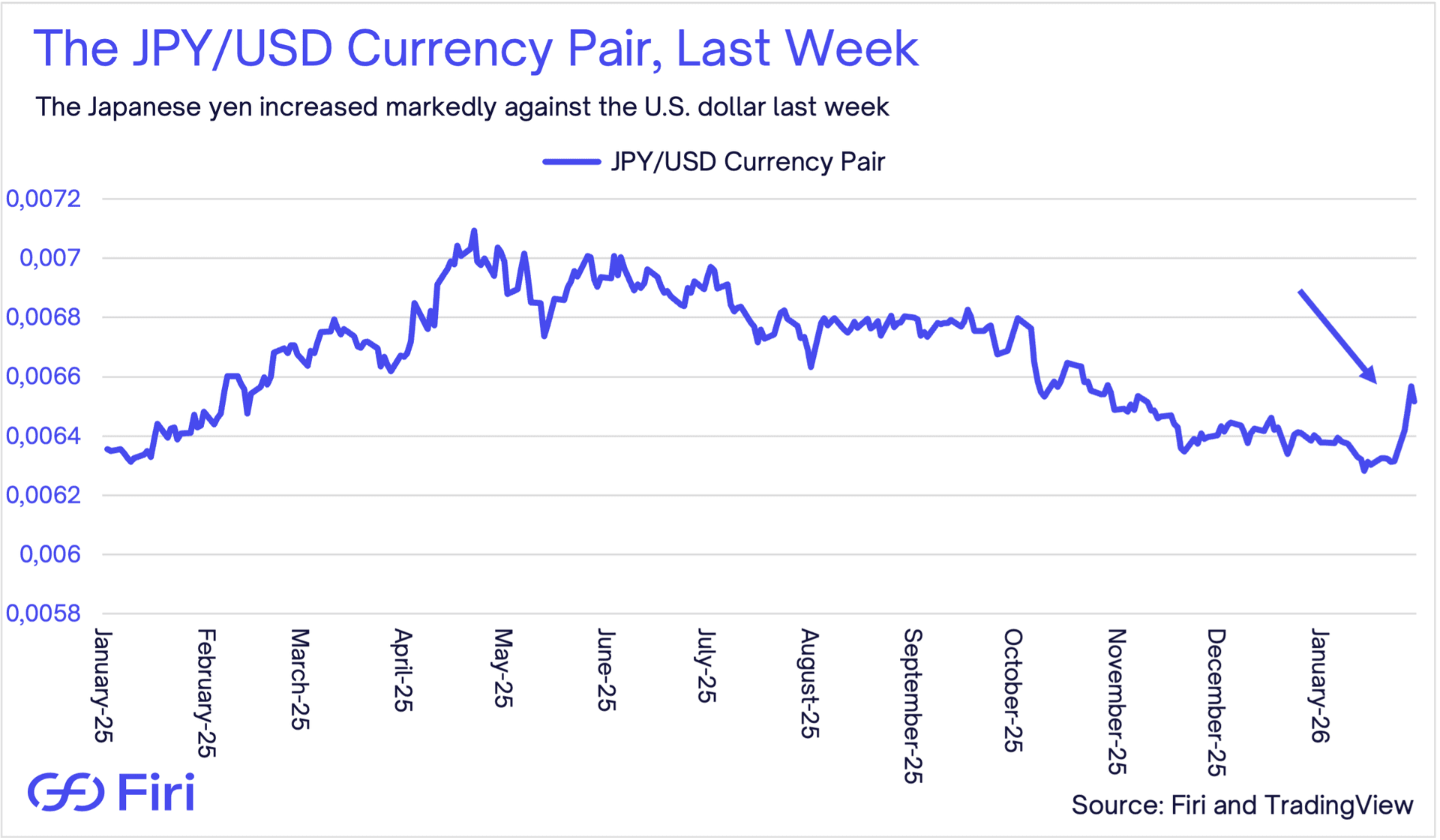
Chart 1: The JPY/USD Currency Pair
Firi illustration

On Friday, the Japanese yen strengthened against the U.S. dollar as speculation built around possible Japanese intervention to support the currency. Some market chatter also floated potential U.S. involvement, though that part remains more speculation than confirmation.

By Sunday, crypto had sold off aggressively in a short span, with Bitcoin dropping to about $86,200 and Ethereum to roughly $2,800 before bouncing modestly—likely driven mainly by this news, and possibly by the prospect of a U.S. government shutdown.

The mechanism in play is the so-called yen carry trade. In simple terms, investors have often borrowed Japanese yen—a low-yielding funding currency—to finance exposure to higher-risk assets, including crypto. When the yen appreciates, that funding becomes more expensive to repay. The result can be a mechanical rush to reduce risk, sell liquid positions, and pay down leverage. If prices are already moving lower, the feedback loop can intensify via margin calls and liquidations.

Importantly, neither Japan nor the U.S. has confirmed intervention. Still, the overhang matters. As long as the market perceives meaningful odds of action to support the yen, the carry-trade unwind narrative will likely continue to sit in the background.

Chart 2: Bitcoin and Ethereum Price Performance During 2025 Shutdown
Firi illustration

During the most recent U.S. shutdown period from October 1 to November 12, 2025, Bitcoin fell about 9.5% and Ethereum about 17.0%. That drawdown was clearly not merely driven by the shutdown, but also by factors such as a major liquidation event in October, extreme U.S.–China trade tensions, and broader concern about whether the rally in AI-linked equities had become overstretched.

Even so, shutdowns tend to be negative for risk-on assets, including crypto. When government operations pause, key economic data can be delayed, making it harder to price growth and inflation in real time. That uncertainty typically pushes investors toward caution. Shutdowns are also economically costly, which can weigh on sentiment more broadly. This time, when the potential shutdown is partial and narrower in scope, the impact may be less severe, but the direction of travel for risk appetite is still usually negative.


A Number to Remember

22,305 bitcoins

Last week, Strategy, the largest corporate holder of bitcoin, added another 22,305 bitcoins, worth close to $2 billion at current prices. This was its largest single bitcoin purchase in more than a year.

On Our Radar

On our radar for the week ahead:

  • Will There Be a U.S. Government Shutdown? If a partial shutdown begins on January 30, it could add another layer of uncertainty for crypto, particularly through delayed macro data, noisier interest-rate expectations, and a likely weaker U.S. economy. If a shutdown is avoided, that would likely lead to near-term relief given how much probability markets are already assigning to a potential shutdown.
  • What About the U.S. Clarity Act? A U.S. shutdown could slow progress on the U.S. Clarity Act, a proposed framework intended to clarify crypto market regulation. Progress would likely be constructive for sentiment, whereas delays would probably be seen as negative by markets.
  • Will Japan Support the Yen? Any concrete signals from the Japanese government about currency support will matter, especially if they meaningfully change expectations for the yen carry trade. If currency intervention looks likely soon, investors often cut back quickly on borrowed, high-risk bets—and crypto is usually one of the first assets they sell.
Portrait of Mads Eberhardt, Cryptocurrency Analyst at Firi.

Mads Eberhardt

Written 28/01/2026

Should not be considered financial advice. Crypto may involve high risk.