Firi Weekly: Did Markets Shrug Off the Middle East Conflict?

Firi Weekly: Did Markets Shrug Off the Middle East Conflict?

  • Crypto Rallies on Middle East Hopes:
    • Bitcoin rose to $78,300 and Ethereum to $2,460, their highest levels since early February, as markets reacted to shifting signals around the Middle East conflict and ceasefire talks. Meanwhile, the largest corporate holders of Bitcoin and Ethereum, respectively, made large purchases, while U.S. crypto ETFs saw solid inflows.
  • $292 Million DeFi Hack Hits Crypto:
    • Parts of the Kelp decentralized protocol were hacked, with crypto worth about $292 million stolen. This prompted freezes on related decentralized markets and undermined trust in decentralized finance (DeFi), as the total value locked across all DeFi protocols fell sharply.
  • Charles Schwab Launches Spot Crypto Trading:
    • The large U.S. brokerage Charles Schwab announced last week that it would roll out direct Bitcoin and Ethereum trading. This matters in particular because the firm has 39.1 million accounts and $11.77 trillion in client assets.
  • France Supports Euro Stablecoin Project:
    • French minister Roland Lescure backed the Qivalis euro stablecoin, which is currently supported by 12 major European banks, including two Nordic banks. Lescure argued that Europe must reduce its reliance on dollar stablecoins, which are 430 times larger than euro-denominated stablecoins.

Last Week’s Big Three

$292 Million Hack Triggers $11.8 Billion DeFi Exodus: A so-called crypto bridge was hacked on Saturday last week. A bridge allows users to move cryptocurrencies between blockchains, and these have historically been vulnerable to hacks. In this case, the compromised bridge belonged to Kelp, an Ethereum restaking protocol. The attackers stole 116,500 rsETH tokens, worth about $292 million. However, 30,766 Ether have since been recovered. These tokens are effectively restaked Ether, meaning they are used to validate and secure other protocols or blockchains.

Large decentralized lending protocols such as Aave have frozen markets tied to rsETH, meaning users currently cannot make new deposits or borrow against rsETH. This is clearly negative for the crypto market, not only because some users lost money, but also because it undermines trust in DeFi protocols. Since Saturday, the total value locked across decentralized protocols has fallen from $98.5 billion to $86.7 billion.

Charles Schwab Launches Crypto Trading: Charles Schwab, one of the largest traditional U.S. brokerage firms, announced last week that it will launch direct spot trading in Bitcoin and Ethereum through its new Schwab Crypto platform, which is set to roll out in the coming weeks. Charles Schwab has 39.1 million brokerage accounts and $11.77 trillion in total client assets. The company first floated the idea of launching spot crypto trading in November 2024, and those plans became more concrete during 2025.

This also reflects a broader trend, with traditional banks and financial institutions gradually beginning to offer crypto trading in Europe and other parts of the world. That has been especially evident in Europe since the European Union’s Markets in Crypto-Assets (MiCA) framework came into force on 30 December 2024. MiCA has not only regulated crypto companies, but also created greater flexibility for traditional financial institutions to engage with crypto.

French Minister Backs the Qivalis Euro Stablecoin: French finance minister Roland Lescure expressed support for the euro-denominated stablecoin Qivalis, which is planning to launch in the second half of 2026. The Qivalis initiative is currently a partnership between 12 major European banks, including Danske Bank and Sweden’s SEB. Lescure argued that the scale of euro stablecoins relative to dollar stablecoins is inadequate, noting that dollar stablecoins are 430 times larger. In his view, that makes this an issue of European sovereignty, particularly in future payment infrastructure.

This is an important development, as public support for crypto in Europe matters for the sector going forward and has arguably been missing for years.

Behind the Charts

Chart 1: Bitcoin and Ethereum Price Performance, Year-to-Date
Firi illustration

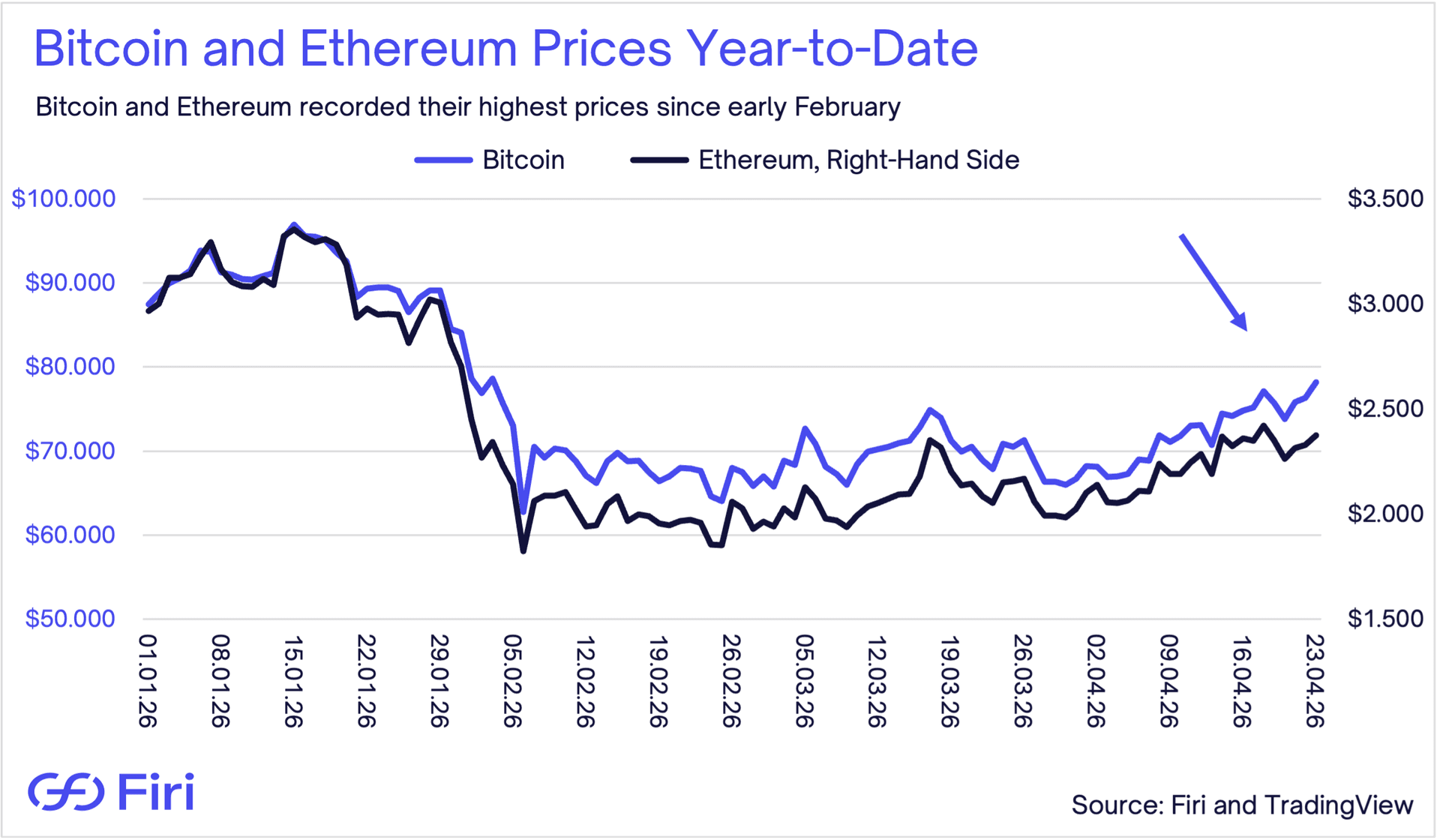
Last week, both Bitcoin and Ethereum reached their highest prices since early February. Bitcoin rose as high as $78,300 and Ethereum as high as $2,460.

Although the conflict in the Middle East has not ended, markets now appear to believe it may only be a matter of time before that happens. That seems to have been the main driver behind the positive price action over the past week. Meanwhile, other risk-on asset classes, such as technology stocks, have also rallied.

The past week was eventful in that respect. One of the most notable developments came late last week, when Iran said the Strait of Hormuz would reopen to all traffic. However, the U.S. did not roll back its naval blockade on vessels passing through the strait to or from Iranian ports. Iran then shut the strait again just 24 hours later. After that, there was considerable discussion over whether the U.S. and Iran would meet again in Islamabad, Pakistan, this week to negotiate a long-term deal, but that was later scrapped. Meanwhile, U.S. President Donald Trump reportedly extended the ceasefire until talks between the U.S. and Iran are “concluded”.

That said, there is still a meaningful risk that no long-term deal is reached and the war continues. Both sides continue to send conflicting signals each day, and that could have a significant impact on markets going forward.

Chart 2: Weekly U.S. Bitcoin and Ethereum ETFs Net Flow
Firi illustration

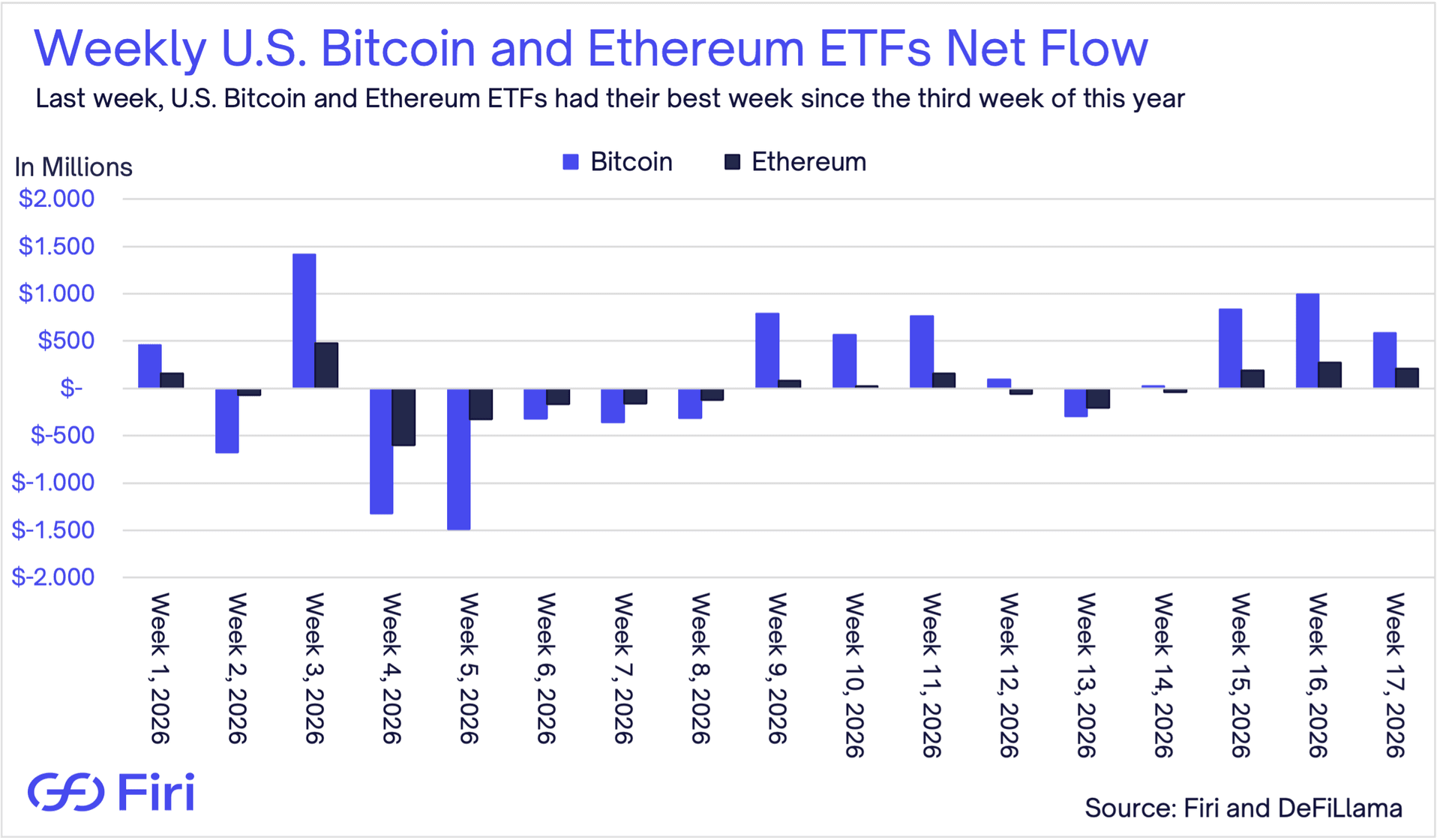
Last week, U.S. Bitcoin and Ethereum exchange-traded funds (ETFs), listed funds that track the price of the underlying assets, posted their second-highest weekly net inflows of 2026 so far. U.S. Bitcoin ETFs recorded net inflows of $996.5 million, while U.S. Ethereum ETFs recorded net inflows of $275.9 million during the week. In practice, that means investors bought more of these funds than others sold, forcing ETF issuers to acquire crypto in the spot market.

The only stronger week this year was the third week of 2026, when U.S. Bitcoin ETFs saw net inflows of $1.417 billion and U.S. Ethereum ETFs saw net inflows of $479.3 million.


A Number to Remember

101,627 Ether

Last week, BitMine, the largest corporate holder of Ethereum, bought 101,627 Ether for slightly more than $230 million, although the purchase was only announced on Monday this week. The firm now holds 4.98 million Ether, worth about $11.96 billion, equal to more than 4% of Ethereum’s total supply of 120.7 million Ether. This was BitMine’s largest purchase since mid-December last year.

On Our Radar

On our radar for the week ahead:

  • The Middle East Conflict: What is likely to matter most for financial markets in the near term, including crypto, is what happens between the U.S. and Iran, and the broader conflict in the Middle East. One thing seems fairly clear: conflicting signals are likely to continue, which means volatility could remain elevated.
  • Will Investors Keep Buying the ETFs? More traditional investors, who often gain crypto exposure through these ETFs, were in buying mode last week. We will be watching whether that continues, as it would indicate that they are still willing to increase their exposure to crypto.
  • Was That It for the Corporates? BitMine was not the only corporate buyer last week. Strategy, the largest corporate holder of Bitcoin, also added to its position. That was presumably another factor behind last week’s rise in crypto prices. As a result, we will be watching whether both firms continue their respective buying sprees.
Portrait of Mads Eberhardt, Cryptocurrency Analyst at Firi.

Mads Eberhardt

Written 23/04/2026

Should not be considered financial advice. Crypto may involve high risk.